
Haiku Deck Superstar
1 Haiku Deck
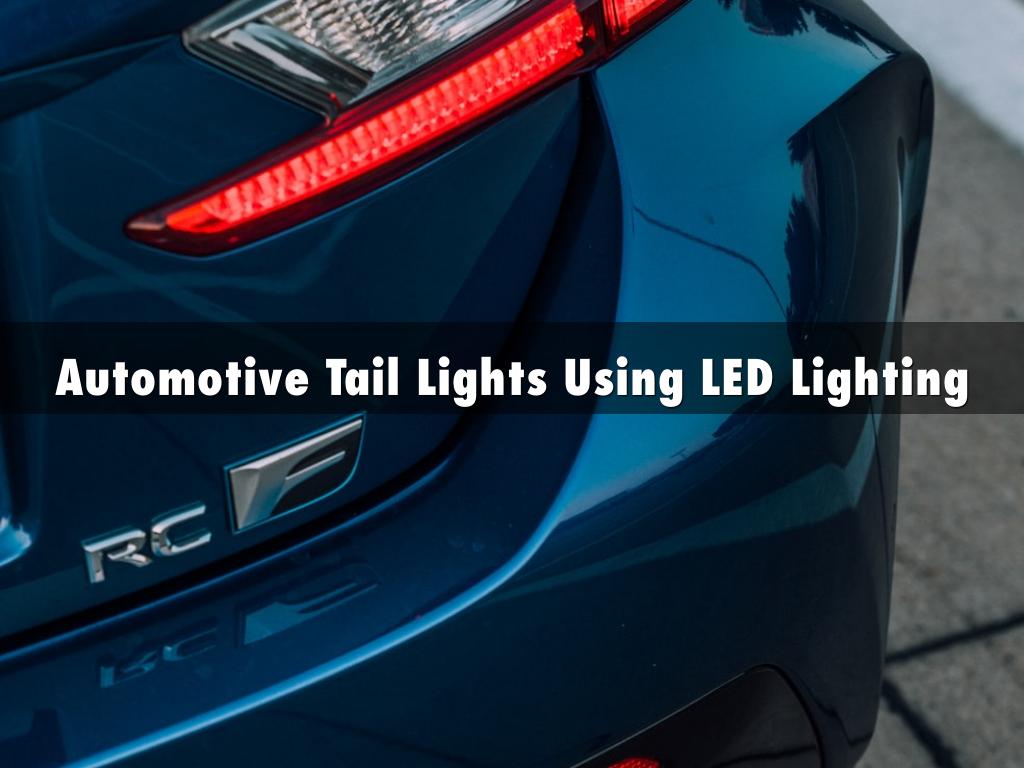
Automotive Tail Lights Using LED Lighting
1 Slide2 Views
Business
Over the last century, there has been a significant decline in the usage of conventional incandescent light bulbs. LEDs now serve as a substitute for this in both interior and outdoor applications. As a kind of transistor, LEDs, sometimes referred to as Light Emitting Diodes, have a substrate that produces light whenever current is applied. LED lights are the digital counterpart to incandescent lights, which are more analog in nature. Since LEDs may be installed almost anywhere and, in any configuration, they are often employed to develop novel applications. There are numerous noticeable benefits of LED lighting over incandescent lights.
On the 1984 Corvette model, LED lights were first used to the tail lamps. LED tail lights make sense since they glow 0.2 seconds quicker than incandescent lights, which ultimately benefits the motorist behind you. This will certainly come in handy, particularly on highways where cars are moving quickly. In the event of a sudden halt, LED lights may assist in preventing an accident.
The color that LED lights provide is also highly advantageous to the driver. When compared to incandescent lights, LED lights generate more vivid color that is more obvious, which when combined with its speedy illumination, helps drivers drive safely on any road.
Even some LEDs can alter their hue. They are called RGB LEDs, or Red-Green-Blue LEDs. RGB LEDs may be made of a single LED that is coated with various materials to produce red, green, and blue light when current is applied, or they can be made of three distinct LEDS—one for each of the three colors—in a single unit. These varied hues may be obtained by varying the voltage.
The human eye detects white light when Green, Red, and Blue are combined at equal brightness; all other combinations and mixtures result in different hues. Due to their compact size, LED lights may even be hidden in places where it would be impossible to use traditional illumination. Daytime running LEDs are also very energy-efficient since they produce far less light than your car's automated lights do.
Other benefits of LED lights include their propensity to endure the full lifespan of the vehicle, resistance to vibrations, ability to light up more quickly than incandescent bulbs, ability to emit a variety of colors, ability to provide lighter per watt than incandescent bulbs, etc. These are a few of the key benefits of LED lighting, particularly vehicle LED tail lamps.